You booked the container. Now you want to know what actually happens when the truck pulls in.
Most delivery guides tell you to level the ground and clear a path. That advice is fine as far as it goes. It also skips the parts that decide whether your drop works. Which trailer we send. How much straight-line room the driver needs. What Minnesota frost does to your delivery window.
Here is our real shipping container delivery process, start to finish. We have run it out of our Grand Rapids, Ellendale, and Stewartville yards since 1997.
Before delivery day: the site check that prevents a failed drop
We confirm your site before we load a container. This call takes a few minutes and saves a wasted trip.
We ask about four things:
- The surface where the container will sit
- The path the truck will take to reach it
- Anything overhead along that path
- Which way you want the doors to face
Door direction matters more than people expect. Once a container is set, moving it means another truck visit. Decide before we arrive whether you want the doors facing your house, your shop, or the road.
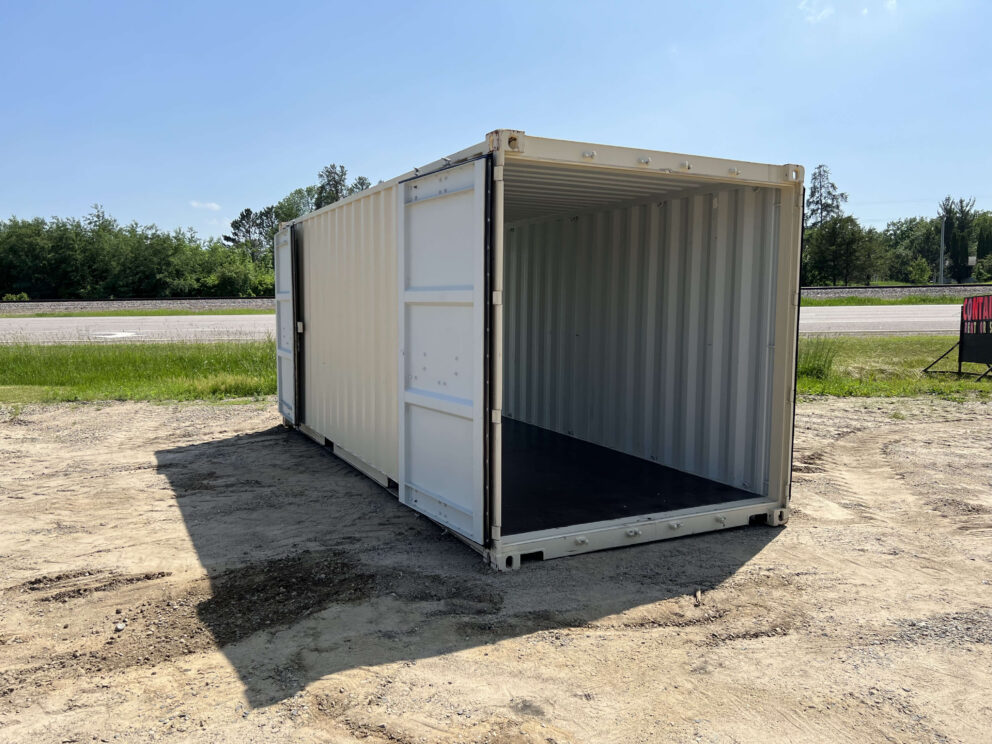
You should also pick your unit before delivery day. You can visit any yard and choose the exact container you want. Browse our container gallery first if you want a sense of condition and color.
Tilt-bed vs side-loader: how we match the trailer to your site
We run both tilt-bed and side-loading trailers. Most companies run one. The difference changes what your site needs.
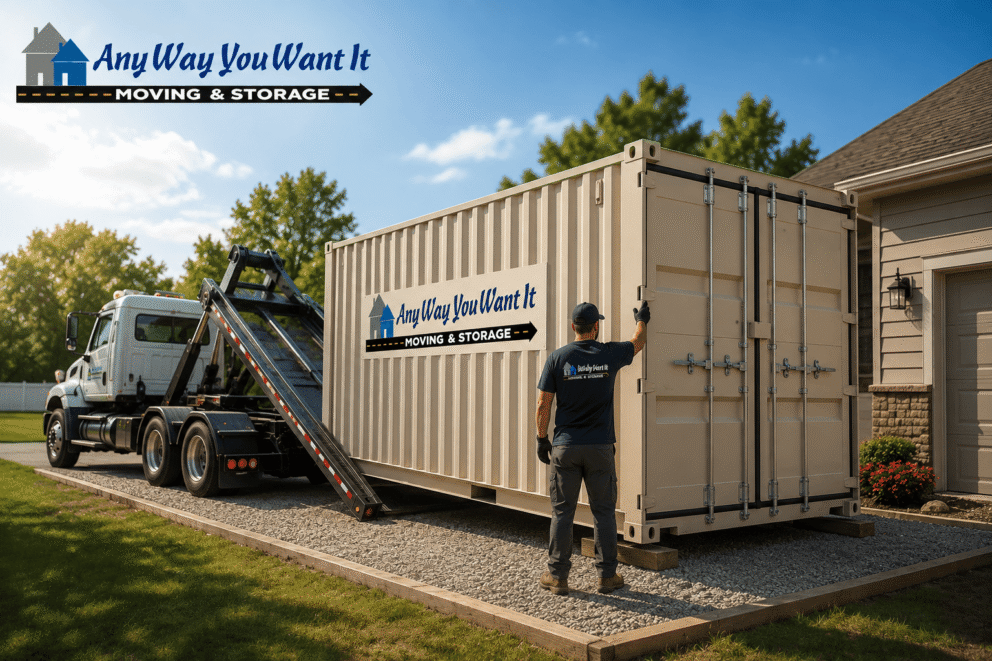
Tilt-bed. The trailer bed tilts back until the container touches the ground. The truck then drives forward and slides the container off. This method needs a long straight run behind the truck.
Side-loader. Hydraulic cranes on the trailer lift the container off the side and set it down. This works in tight spots where a tilt-bed cannot back up far enough.
We pick the trailer based on your site, not on what is parked closest. Tell us about a narrow driveway or a fence line and we plan around it.
Either way, your container arrives at ground level. You do not need a crane, a forklift, or any equipment of your own.
How much room the truck needs for container placement
Two measurements matter. The first is the footprint. The second is the approach.
A 20-foot container needs a flat spot about 8 feet wide and 22 feet long. A 40-foot unit needs roughly twice that length. Our 10-foot containers fit in far tighter yards, which is why they work well on small residential lots.
The approach is the part people underestimate. A tilt-bed drop needs a straight, clear line well beyond the container itself. Plan on roughly 60 to 70 feet for a 20-foot container and 100 feet or more for a 40-foot container. Call your yard to confirm the number for your specific trailer and site.
Overhead clearance gets missed the most. Look up before you commit to a spot. Power lines, branches, gutters, and low garage roofs all stop a delivery cold.
Leave the working room at the door end too. Container doors swing wide, and you will want space to load without squeezing past a fence.
Minnesota frost laws that affect your delivery window
This is the part almost no delivery guide covers, and it is the one that can move your date.
MnDOT splits Minnesota into six frost zones. Each spring, as the ground thaws, the state posts spring load restrictions on trunk highways. Gravel roads drop to 5 tons per axle. Paved roads get posted at 5, 7, 9, or 10 tons. The limits apply to the combined weight of the truck and its load.
The timing runs on a real schedule. In 2026, restrictions started March 3 in the southern zones and lifted April 20. The North zone started March 20 and stayed restricted until May 15. County and city roads follow their own postings, which can differ from the state.
An empty container is heavy on its own. A 20-foot unit weighs roughly 4,850 to 5,200 pounds. A 40-foot unit runs around 8,265 pounds. Add the tractor and trailer to that. On a posted gravel road in April, the trip stops being a mud question and becomes a legal one.
What this means for you:
- Book early if you need a container in March, April, or early May
- Expect a later thaw window in Grand Rapids than in Ellendale or Stewartville
- Tell us if your driveway or access road is gravel or township-maintained
We track the postings for our routes. If a restriction affects your address, we tell you before you plan around a date.
Source: MnDOT Seasonal Load Limits
Delivery day, step by step
Here is what you will see.
We call ahead. You get a heads-up on timing before the driver rolls out. If something shifts, you hear about it from us.
The driver walks the site. Before backing in, the driver checks the surface, the approach, and the overhead. If a spot has gone soft since your site check, we talk it through with you on the spot.
The truck lines up. For a tilt-bed drop, the driver backs into a straight line. The rear of the trailer lands at the far end of the placement spot. For a side-load, the truck parks parallel to that spot instead.
We set the container. Tilt-bed drops slide the unit off as the truck creeps forward. Side-loaders lower it straight down. The whole placement usually takes minutes, not hours.
We level it. If the ground slopes or feels soft, the driver sets wood blocking under the corner castings. Level corners keep the doors swinging true. A container that sits twisted will bind at the doors within a season.
You check the doors. Open and close them before the driver leaves. This is the single best two-minute check you can do. If something is off, we fix it while the truck is still there.
You sign off. Then the container is yours to load on your own schedule.
Ground conditions that trip up Minnesota deliveries
Every delivery guide says level ground. Minnesota adds three problems that generic advice ignores.
Spring mud. Thawing ground looks solid and is not. A loaded truck can sink to the axles in a yard that held a pickup fine the week before. Gravel, asphalt, and packed crushed rock all beat bare soil in April.
Frost heave. Ground that freezes and thaws lifts unevenly. A container set flat in October can sit crooked by March. Blocking under the corners gives the unit a stable footing and helps it ride out the cycle.
Snow and ice. Snow hides ruts, stumps, and soft spots. It also makes a sloped driveway a hazard for a heavy trailer. Clear and sand the drop area before we arrive in winter. Our post on preparing your container for winter covers what to do once the unit is in place.
Drainage deserves a look too. Avoid low spots where meltwater pools. Standing water speeds up rust on the underside and can freeze the doors shut.
What happens after we set the container
You load on your own timeline. There is no truck idling in your driveway and no clock running.
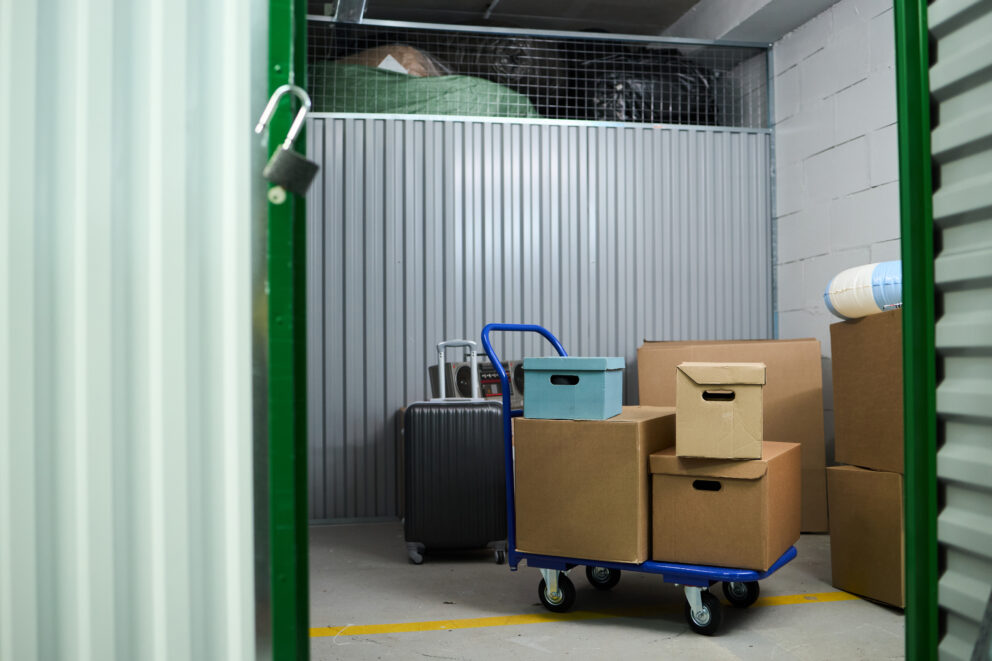
When you finish, call us and we pick it up. We move full and empty containers, so you do not have to unload first if you are relocating the contents. That flexibility is why portable storage works well for moves that stretch across several weeks.
If you decide you want more than a plain steel box, we handle container modifications in house. Roll-up doors, windows, insulation, shelving, and paint all get done at the yard before delivery.
Delivery day FAQs
Do I need to be home when the container arrives?
It helps. Someone on site can confirm placement and door direction before the driver sets the unit. If you cannot be there, mark the spot clearly and send us a photo beforehand.
Can you deliver onto grass or dirt?
Sometimes. Firm, dry, level ground works. Soft or thawing ground does not. Tell us the surface when you book so we can plan the trailer and the timing.
How long does the drop take?
The placement itself usually runs 15 to 30 minutes. Site access is what adds time, not the unloading.
Do I need a permit?
Rules vary by city, county, and township. Some places require a permit for a container on residential property, especially long term. Check with your local zoning office before you book.
Can you move the container after it is placed?
Yes, with another truck visit. That is why door direction and placement are worth getting right the first time.
Do you deliver outside your three yard towns?
Yes. We cover a wide service area from Grand Rapids, Ellendale, and Stewartville, including Rochester and Duluth.
Schedule your container delivery in Minnesota
Good deliveries are mostly good planning. Tell us your surface, your access, and your timeline. We match the trailer and the date to your site.
Ready to book? You can rent a shipping container, buy one outright, or start with rent-to-own.
Call (218) 326-0397 in Grand Rapids or (800) 542-0036 for Ellendale and Stewartville. You can also request a free quote online and tell us your delivery ZIP.
Spring and summer slots fill up during building season. Book early if your date is firm.